
Exploring Navajo Star Ceilings Through Virtual Reality: A New Frontier in Rock Art Documentation
by Tom Christian, PhD, RPA
Exploring Navajo Star Ceilings Through Virtual Reality: A New Frontier in Rock Art Documentation
Digital representations of archaeological sites are advancing rapidly as interest in digital cultural heritage grows. In fact, new forms of digital representations of archaeological sites, especially at rock art sites, are being investigated vigorously at the present moment (Palonka, et al., 2023). Virtual Reality (VR), once strictly in the domain of the gaming world, is now emerging as a powerful tool for archaeological research, preservation, and public education. I attempted to experiment with VR techniques at an important rock art site and this post offers some highlights of this experimental VR project. The site is representative of a type of rock art style known as the “Navajo Star Ceiling;” these rock art sites are attributed to the Navajo people and they are dominated by cruciform icons that are meant to symbolize the stars of the night sky. This particular site is located in the Jemez Pueblo region.

Example of a cruciform star icon.
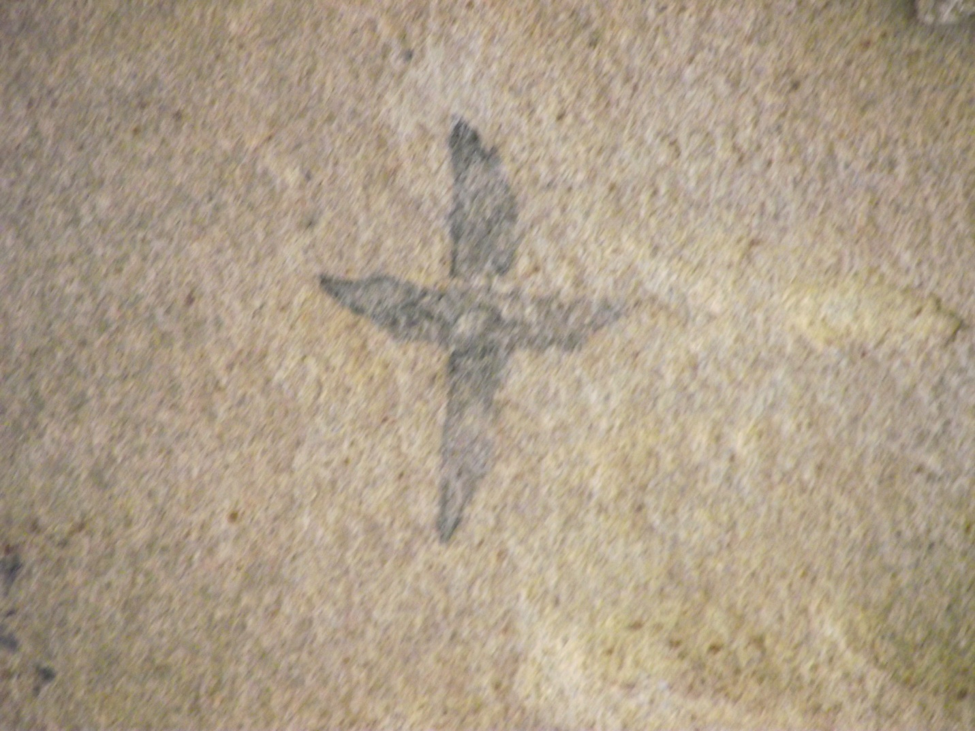
Example of a cruciform star icon.
Why VR for Rock Art?
Photogrammetry has been used in archaeological-type recordation since the mid‑1800s (Alberz 2001), but recent advances now allow researchers to create immersive 3D and VR experiences using photogrammetry methods.
VR is proving especially promising for rock art studies. Torres et al. (2024) demonstrate how VR enhances “knowledge transmission” and supports “historical empathy,” while Palonka et al. (2023) show that multi‑method digital approaches can produce highly accurate and data‑rich representations of Native American rock art. (Both of these studies are well worth reading!)
Until this particular pilot project, VR has never been applied to Navajo star ceiling sites.
Introducing the Star Ceiling Site
This site is located near Jemez Pueblo, and it forms the primary focus of the VR experimentation. This site contains a dense concentration of star imagery, mudballs, and other ceiling pictographs, many placed at heights of 15–60 feet. The site’s complexity and verticality make it an ideal candidate for VR documentation.
The VR Capture Process
VR documentation at this site was conducted by using a professional 360° camera with multiple lenses (Insta360 Pro 2) and a DJI Mini 4 Pro drone. The site was recorded as a series of 360° panoramas captured to simulate a walk‑through. Each panorama was captured at a minimum distance of approximately 1.5 meters from the cave walls.
Key technical features included:
a) Isolated exposure for each lens.
b) HDR bracketing for dynamic range.
c) Remote triggering to avoid researcher presence in imagery.
d) 3D stereoscopic capture for depth perception in VR headsets.
Finally, a secure webpage was created to host the 3D and VR renditions.
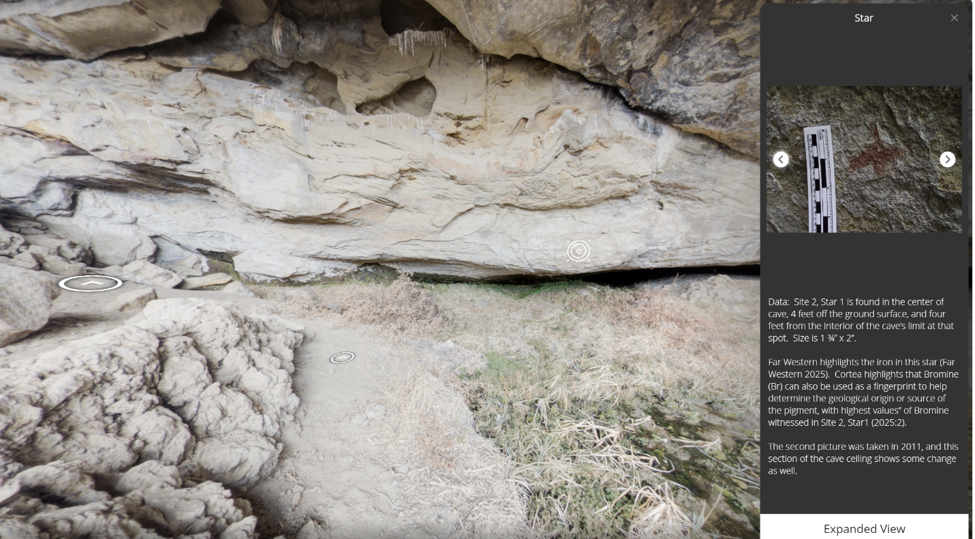
Example of the VR rendition of a section of the cave site with an educational hotspot with descriptions of features.
What VR Techniques Support
1. A Digital Twin of the Site
The VR environment successfully creates a highly immersive digital twin of this important star ceiling site. And VR, in effect, allows researchers to enter a site at any time, from anywhere, and to remain at the site for however long they wish via the VR environment.
2. Evidence of Site Change Over Time
Comparisons between 2011 photographs and 2026 VR imagery reveals changes in pigment vibrancy, mud overlays, and ceiling conditions. VR made these changes/differences more apparent (see images below).
3. Access to Previously Inaccessible Areas
Drone‑based VR capture revealed alcoves and ceiling pictographs unreachable from the floor. Some imagery appears newly recorded simply because drone-based VR techniques enabled access.
4. Educational and Public Archaeology Potential
VR hotspots allow users to click on features and access interpretive content. This transforms the site into an interactive learning environment.
5. Efficiency and Cost Savings
The entire VR capture took approximately two hours, compared to years of traditional documentation. Hosting the VR environment on a secured webpage costs roughly $120–$500 annually, making long‑term digital preservation feasible.
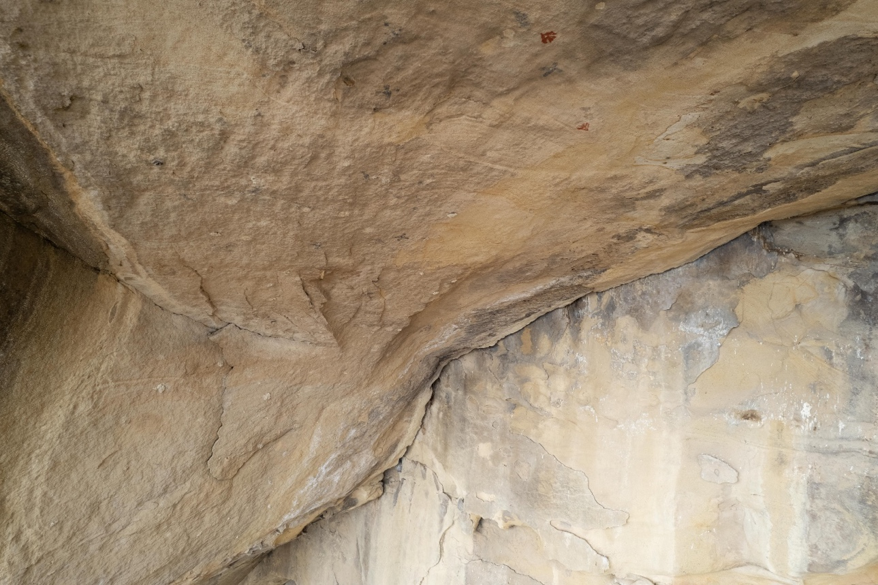
Section of ceiling with pictographs, to include star icons, in 3D. The height of the ceiling here is 60+ feet.
Limitations and Considerations
VR quality depends heavily on the VR capture equipment and technology used in recordation. For this study, while the 360° photogrammetry approach captured ambiance and general detail, sharp detail is somewhat limited in certain area, and extremely sharp detail is needed for rock art studies.
Laser‑based systems (e.g., LiDAR) may produce higher‑resolution results but are significantly more expensive.
Other considerations include:
a) The learning curve of VR headset use; and I have actually found there is a kind of cognitive block to people using VR; as if there is a kind of aversion to the VR world.
b) Rapid evolution of VR technology.
c) The need for secure hosting for ethical digital stewardship.
d) VR’s focus on visual data, which limits certain types of archaeological inquiry.
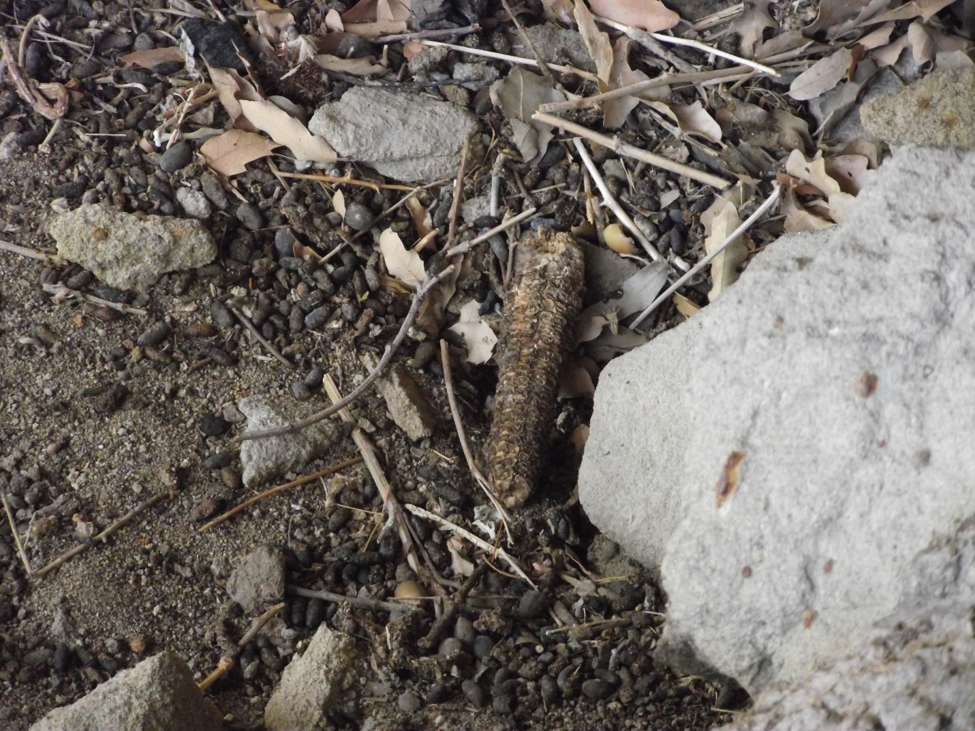
Photograph of a corn cob and other material found at the site in 2011.

The blue outline is where the corn cob was located in the 2011 image. Site change is readily witnessed here. VR can support witnessing and documenting site change.
Why This Matters for Navajo Star Ceilings
This project demonstrates that VR can: Preserve star‑ceiling sites digitally; support Native American heritage access and VR tourism; enable researchers to study ceiling imagery without physical risk; provide long‑term monitoring of site change; and expand educational access to culturally sensitive sites.
VR is not a replacement for traditional archaeology, but it is a powerful tool, especially for fragile and/or remote rock art sites like the Navajo star ceilings. As for the deep ethics regarding using VR for sacred rock art, that’s an important matter for another blog post.
References
Albertz, J. 2001. Albrecht Meydenbauer – Pioneer of Photogrammetric Documentation of the Cultural Heritage. In Proceedings of the 18th International Symposium CIPA, Potsdam, Germany, 19–25. http://www.theulegium.de/fileadmin/user_upload/Texte/Meydenb.pdf
Palonka, R., P. Schaafsma, V. M. MacMillan, and P. Micyk 2023. Digital Documentation and Analysis of Native American Rock Art and Euro-American Historical Inscriptions from the Canyons of the Ancients National Monument, Colorado. Antiquity. 97(393). https://www.cambridge.org/core/journals/antiquity/article/digital-documentation-and analysis-of-native-american-rock-art-and-euroamerican-historical-inscriptions-from-the canyons-of-the-ancients-national-monument colorado/6CD99CCCFA06A851171D7564ABD701F8.
Torres, A., M. Á Medina-Alcaide, I. Intxaurbe, O. Rivero, J. Rios-Garaizar, M. Arriolabengoa, J. F. Ruiz-López, and D. Garate. 2024. Scientific Virtual Reality as a Research Tool in Prehistoric Archaeology: The Case of Atxurra Cave (Northern Spain). Virtual Archaeology Review 15(31): 1–15. https://doi.org/10.4995/var.2024.
If the reader wants to learn more about Navajo star ceilings, there are many wonderful studies offered by Von Del Chamberlain and Polly Schaafsma. I also encourage people read Stephen Jett’s work and Claude Britt’s work. You can also look at my small book on the subject: Shooting for the Stars: A Brief Look at Navajo Star Ceilings. It’s available on Amazon: https://www.amazon.com/stores/Tom-Christian-PhD/author/B0H576L4KR?ref=ap_rdr&shoppingPortalEnabled=true&ccs_id=df018c2c-323b-45fc-9b36-b30246ba6a70
Tom Christian, PhD, RPA (c)


Comments