
AI in Archaeology: Exploring New Frontiers in Digital Rock Art Restoration
Updated: Jul 21
by Tom Christian, PhD, RPA ©
AI is having its time in the sun right now. Since the emergence of deep learning in the 2010s, AI has been revolutionizing the sciences, including how we conduct research in archaeology (Wang et al. 2023). From data collection and generation to pattern recognition, experimentation, and simulation, AI is dramatically impacting the scientific method.
AI's Role in Archaeology
With respect to archaeology, AI is being harnessed for a variety of purposes. For instance, recent studies have shown its potential in site discovery (Sakai et al. 2024), artifact recognition (Anichini et al. 2021), and language deciphering (Jiaming et al. 2019). Moreover, AI supports 3D reconstructions (Massimo et al. 2016), which have become invaluable in visualizing archaeological contexts. The work by Sakai and colleagues (2024) identifying geoglyphs at Nazca via satellite images is perhaps the most well-known application of AI's use in archaeology today.
AI is revolutionizing rock art research in particular. Techniques such as automated rock art recognition and analysis (Horn et al. 2022; Macieira et al. 2025), identification and classification (Horn et al. 2022), and motif extraction (Jalondoni et al. 2022) are transforming how we understand rock art in different geological contexts. Horn and colleagues (2022) predict that the future of AI in rock studies depends on theorizing about rock art itself, suggesting that our cognitive limitations could restrict how we conceive of rock art creation and use. AI certainly has the power to help expand our limitations, or at least to support examining archaeological problems from differing perspectives.
A New Era of Understanding
Jardim and colleagues (2025) trace the trajectory of AI within rock art research, noting that the long-standing reliance on field sketches and photography is evolving into a computational approach capable of automatically reconstructing motifs. They emphasize that:
“AI is not a replacement for archaeological interpretation, but a powerful extension of it. When implemented in a thoughtful manner, these technologies can unlock new layers of meaning in the oldest art forms in the world, deepening our understanding of human history while ensuring its preservation for generations to come” (Jardim et al. 2025:5-6).
Experimenting with AI for Rock Art
In my own work, I experimented with AI to support reconstruction and interpretation of rock art, helping to think about digital conservation and preservation. I have explored its potential to restore and conserve rock art, particularly focusing on rock art of the American Southwest. For instance, I collaborated with Alex Kashkin, a researcher at MIT, who developed an AI technique to restore paintings on a three-dimensional canvas (Chu 2025). Together, we explored the viability of applying his technique to rock art in a digital context via digital restoration. (In actuality, Kashkin donated his time to this small project, and I am grateful to him!)
As I delved into this type of AI rock art research, I aimed to expand our conceptual limitations by using AI to support new ways of thinking about rock art restoration and preservation. At the time of writing this, I found no existing research regarding the utilization of AI techniques with rock art of the American Southwest. Given that AI is on the rise across various fields, I wanted to examine experimental methods using AI for understanding the potential of rock art digital reconstruction and conservation, thereby opening up new avenues for investigating ancient rock art.
Results of the Experiment
In my collaboration with Alex Kashkin, I consulted with him to see if his AI restoration model could work with rock art from the American Southwest (as opposed to paintings on a canvas).
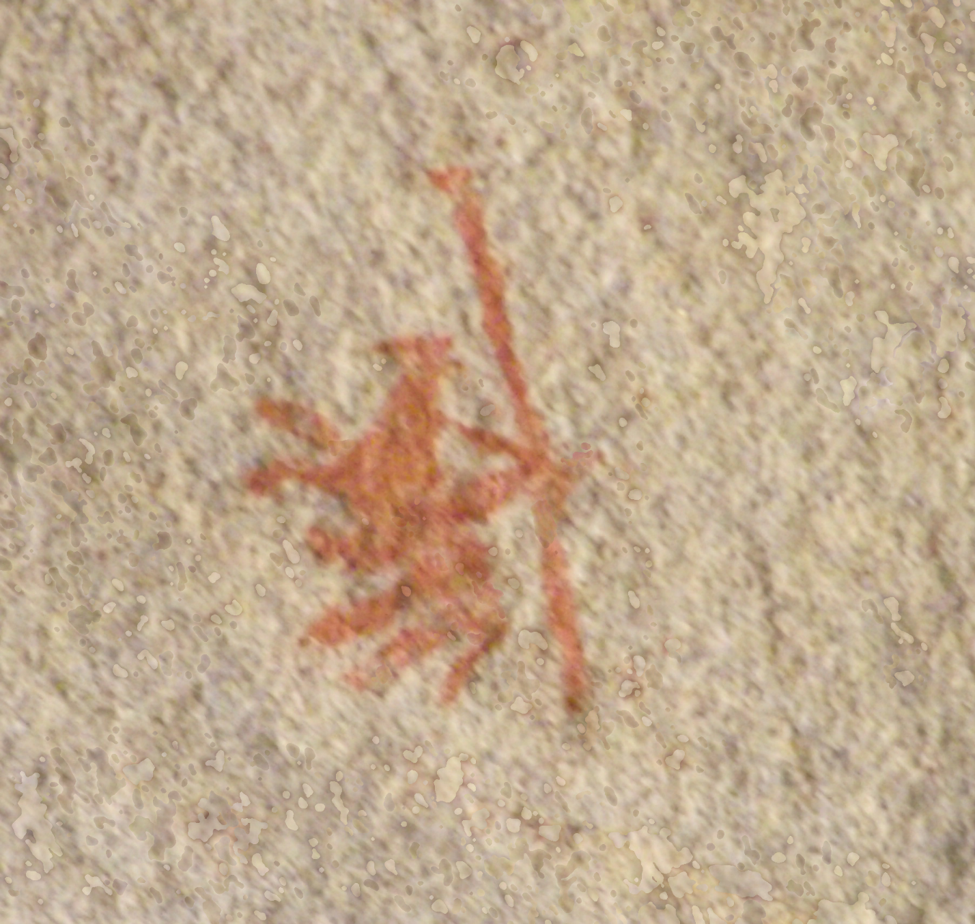
We experimented with his AI restoration model using a pictograph located at a site in Northwestern New Mexico. The process involved feeding a digital image of the pictograph into his AI restoration program.
In essence, the AI-generated restoration process was entirely digital, attempting to apply a digital overlay to fill in areas of visual damage on the image of the pictograph. Although the results were not perfect, they pave the way for further experimentation with this technique.
Figure 1 shows the original image of a pictograph from a site located in Northwestern New Mexico that was fed into Mr. Kashkin’s model. This particular pictograph seems to exhibit a Conquistador on horseback with a lance. It is most likely produced with hematite or red ochre and it probably dates to the time of the Spanish incursion into the Southwest (1500's):

In contrast, Figure 2 displays the AI-generated image of areas needing in-filling via Kashkin’s method, showing the areas that needed repair and restoration:

Finally, Figure 3 presents the final image containing the original photographic image alongside Mr. Kashkin’s AI-produced overlay. This visual comparison highlights the potential of AI in enhancing our understanding of rock art, despite the challenges faced during the restoration process:
Reflections on the Experiment
While this experiment did not yield a perfect digital restoration, it serves as an important proof-of-concept for the application of AI in rock art studies. The challenges faced—particularly the model's struggle to recognize and fill in areas accurately—illustrate the complexities involved in adapting AI tools designed for different contexts.
Mr. Kashkin’s model, tailored for three-dimensional restoration of actual paintings, was not ideally suited for the nature of a digital image of ancient rock art. This mismatch underscores the necessity for developing AI applications specifically designed for rock art conservation.
But importantly, the takeaway is this: AI can be programmed, harnessed, and applied for use with digital restoration and conservation! When you add the component and potential of Virtual or Augmented Reality spaces, then the digital restoration effort could yield some inspiring results!
Conclusion: Embracing AI in the Archaeology of Rock Art
The integration of AI into archaeological practices, particularly in rock art studies, marks a significant turning point in how we approach the preservation, conservation, and interpretation of ancient cultures. The potential for AI to enhance our understanding of rock art is immense, opening new avenues for research and conservation.
While my initial attempts at applying AI to rock art restoration via Kashkin’s model faced challenges, they also laid the groundwork for future exploration. As we continue to experiment with these technologies, it’s essential to maintain a dialogue about their ethical implications and cultural significance.
In conclusion, AI offers exciting possibilities for the field of archaeology. By harnessing its capabilities, we can deepen our understanding of ancient cultures and ensure their legacies endure for future generations.
Ethical Considerations
As with any use of technology in the realm of archaeology, ethical considerations are paramount. The digital enhancement and restoration of sacred images, which may be considered cultural patrimony, must be approached with care. It is crucial to respect the wishes of tribal members regarding their sacred artworks. There may be hesitance or outright opposition to replicating or digitally restoring these significant cultural artifacts.
This highlights the importance of collaboration with Indigenous communities in the research process. Engaging with tribal leaders and cultural custodians can ensure that the use of AI aligns with their values and respects their heritage.
References
Anichini, F., N. Dershowitz, N. Dubbini, G. Gattiglia, B. Itkin, and L. Wolf. 2021. The Automatic Recognition of Ceramics from Only One Photo: The ArchAIDE app. Journal of Archaeological Science: Reports 36.
Chu, J. 2025. Fix Damaged Art in Hours with AI. MIT Technology Review. https://www.technologyreview.com/2025/08/26/1121006/fix-damaged-art-in-hours-with ai/, accessed November 30, 2025.
Horn, C., O. Ivarsson, C. Lindhé, R. Potter, A. Green, and J. Linge. 2022. Artificial Intelligence, 3D Documentation, and Rock Art—Approaching and Reflecting on the Automation of Identification and Classification of Rock Art Images. Journal of Archaeological Method and Theory 29:188–213.
Jalandoni, A., Y. Zhang, and N. A. Zaidi. 2022. On the Use of Machine Learning Methods in Rock Art Research with Application to Automatic Painted Rock Art Identification. Journal of Archaeological Science 144:105629.
Jiaming, L., C. Yuan, and R. Barzilay. 2019. Neural Decipherment via Minimum-cost Flow: From Ugaritic to Linear B. Proceedings of the 57th Annual Meeting of the Association for Computational Linguistics, 3146–3155.
Jardim, S., S. Garcês, and H. C. Giraldo. 2025. From Pixels to Patterns: Artificial Intelligence and Digital Imaging for Rock Art Interpretation. Paper presented at the 5th International Conference on Electrical, Computer, Communications and Mechatronics Engineering (ICECCME), Zanzibar, Tanzania. DOI:10.1109/ICECCME64568.2025.11277699.
Macieira, B., H. Pereira, H. Nogueira, J. Pomba, S. Garcês, and S. Jardim. 2025. Exploring Artificial Intelligence Capabilities in the Detection and Classification of Prehistoric Rock 203 Art Paintings. In Proceedings of the Future Technologies Conference (FTC) 2025 1676:530–546.
Massimo, V., P. E. Bagnoli, C. Mannu, and G. Rodriguez. 2016. Photometric Stereo 3D Visualizations of Rock-Art Panels, Bas-Reliefs, and Graffiti. In CAA2015. Keep the Revolution Going, edited by R. Scopigno, S. Campana, G. Carpentiero, and M. Cirillo. Archaeopress Publishing, Bicester, Oxfordshire, United Kingdom.
Sakai, M., A. Sakurai, C. Lu, J. Olano, C. M. Albrecht, H. F. Hamann, and M. Freitag. 2024. AI Accelerated Nazca Survey Nearly Doubles the Number of Known Figurative Geoglyphs and Sheds Light on Their Purpose. In Proceedings of the National Academy of Sciences 121(40). https://doi.org/10.1073/pnas.2407652121, accessed March 23, 2025.
Wang, H., T. Fu, Y. Du, W. Gao, K. Huang, Z. Liu, P. Chandak, et al. 2023. Scientific Discovery in the Age of Artificial Intelligence. Nature 620:47–60.


Comments