
The Canvas of the Heavens: A Brief Look at Native American Stellar Iconography and Painted Hides
By Tom Christian, PhD
The Benevides Mission
Because of the Rodriguez and Espejo expeditions, many sought to settle in New Mexico. Juan de Oñate (1598) gained permission from the king to colonize and create a government there, settling at the San Juan Pueblo and becoming the first governor of New Mexico.
Three decades after Oñate established his governorship of New Mexico, the Portuguese Franciscan friar, Alonso de Benevides, launched the first large-scale Christian mission in the New World, aiming to bring the Christian Church into New Mexico and convert “the heathen-filled territory to save the inhabitants’ souls.”
Benevides’s account of his 1630 expedition is “likely the first comprehensive account of the colony (New Mexico) to make its way into the hands of the Spanish monarch [King Philip IV]” (Morrow xi). Benevides described the “Apaches de Navajo,” a nation that surrounded the Puebloans “everywhere” (57). He and his priests risked their lives to, in their words, “domesticate the natives,” moving from mountain range to mountain range in tents and small huts.
Though they spoke different languages than the Puebloans, the different groups of Apaches could understand each other; they were loud, and “their only idolatry is worship of the sun,” though that is not universal among them (57). Benevides deemed the Apache nation “spirited and bellicose folk” (57). In his description of the conversion of the Gila Apaches, Sanaba, the Gila Apache captain, came to meet Benevides with a well-cured deerskin.
Benevides’ description is as follows: “Sanaba says, ‘unfold that skin and see what’s inside.’ I did just that. It was large and very white, and I saw painted in the middle of it a green sun with a cross above it. Below the sun was a grayish-brown moon, with another cross over it” (Benevides 60–61).
Asking what they meant, Sanaba [perhaps coyly] said:
“Father, until now we’ve known no benefactor as great as the sun and the moon. The sun warms us and lights the world by day and causes our plants to grow. The moon lights us by night. And so we have worshipped these two, as we would anything that had done so much good for us, and we didn’t know that there was anything better. But now that you have taught us that God is our Lord and Creator of the sun and moon, and of all things, and that the cross is the symbol of God, I have ordered that the cross be painted over the sun and over the moon. This is so that you will understand that we do what you teach and that we do not forget that, above all, we will worship God and His holy cross.” (Qtd. in Benevides 60–61)
Benevides’s account is the first time the Apaches de Nabajo or the Navajo as such are described in the historical record, as well as the first time a cross is witnessed among any Apachean people by Europeans. Benevides translates Navajo to mean “big planted fields” (Benevides 62), and he called them this because they planted crops, which was unusual for the Apaches that he encountered. Of course, Benevides may be off in naming the Navajo, “Apaches”!
While the Spanish, including figures like Cabeza de Vaca, frequently interpreted the presence of crosses at indigenous cave and spring sites as evidence of Christian influence, this conclusion overlooks a deeper indigenous influence and chronology. In reality, the cruciform icon was an established element of Native American visual language long before European contact, serving as a sophisticated symbolic representation of the sun and the stars. This is how Cabeza de Vaca was able to excite his Native American companions with his own version of the sign of the cross as he trekked across the Southwest and possibly the reason why he was called “son of the sun.”
It is interesting to note that in relation to the scene recorded by Benevides above, Sanaba presented a cruciform image indicating direct association with a heavenly body, as exhibited by Apachean people.
The Skidi Pawnee Chart of the Heavens
Circling back to Benevides’s description of Sanaba’s deerskin, I wish this deerskin still existed. It may be archived somewhere, deep in an archived collection, perhaps in Spain; but I could not find this particular buckskin. There are other examples, however, of this type of deerskin with stellar images, and it’s worth offering an important example here (Figure 1). This example is not Navajo or Apachean; rather, it is from the Pawnee tribal culture, yet it provides a visual reference point for a painted buckskin in the way Benevides describes seeing one.

Figure 1, Digitized Sketch Star Map known as The Skidi Pawnee Buckskin Chart of the Heavens. It is said the size of a star on the skin depends not only on its brightness in the sky, but also on its assumed power. The Chicago Field Museum maintains the original buckskin in its collection.
This example is known as the Skidi Pawnee Chart of the Heavens. As we look upon it, we are offered a window into the type of experience Benevides must have had when he viewed Sanaba’s buckskin. The beauty of this artwork is readily apparent. It is absolutely breathtaking. And it is extremely important to the Skidi Pawnee. The emphasis on cruciform stellar icons as representing stars, some arranged as constellations, is also clearly seen here.
Given how often cruciform icons are witnessed among Native American groups, and as representing stars and other night sky phenomena, this can be taken as evidence that cruciform icons as depicting stars are a culturally shared symbol; this symbol transcends geography, culture, and language. This insight is worth further investigation.
Briefly, the Skidi Pawnee are known to have patterned their lives from observations made of the sky. Their relationship to the natural world and organization were defined by the movement of the heavens. Their homes were constructed as heavenly observatories and these homes were also built to reflect the pattern of the night sky on earth in their layout. Political leadership was also meant to be witnessed in the sky and thereby reflected on earth (Chamberlain 1983).
According to Von Del Chamberlain (1983): “We see that the Skidi based their lives on observations of the heavens. From such observations they judged their origins, determined their calendar and managed time, and derived principles of leadership and community. Their celestial orientation helped them feel secure either out on the vast prairie or within their homes that were microcosms of the greater world around them.”
Given how much the Skidi Pawnee relied upon the sky, it is little wonder that they produced such an amazing piece of functional art that can be said to be at once a kind of bridge between earth and sky and also to symbolically act as a map of the heavens.
So many other Native American cultures pattern life on earth with the pattern of the heavens!
Another example of something akin to Sanaba’s buckskin is an Apachean buckskin painting that I found on an auctioneer’s webpage (already sold).
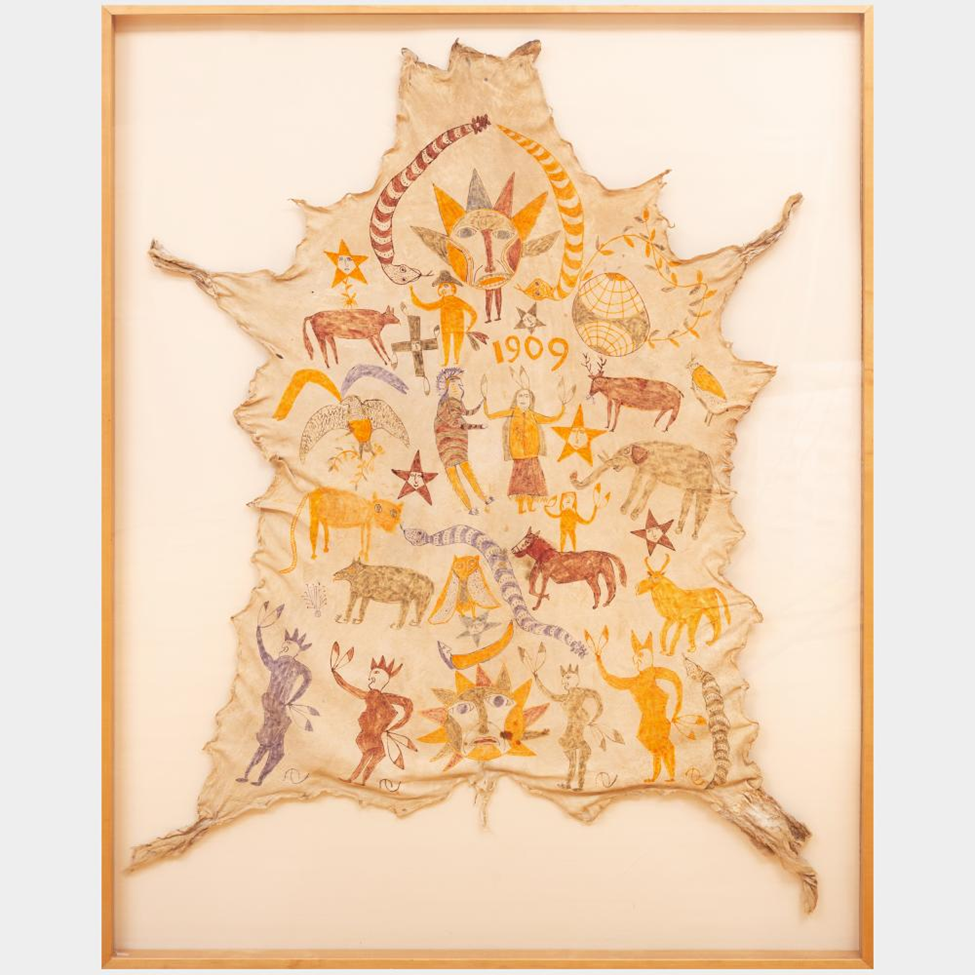
Figure 2, Apache Deerskin, Painted 1909 (https://www.invaluable.com/auction-lot/apache-deer-skin-painting-88-c-aee4132869)
In this painting we can see some of the detail that is described by Benevides in Sanaba’s deerskin. My interpretation is that the two large faces replete with rays found respectively at the top and the bottom of the deerskin are most likely representative of both the Sun and the Moon. We can discern a “cross” located to the bottom left of the uppermost face and interspersed throughout the artwork we can see five-pointed stars with faces drawn inside them. Again, this painting is attributed to the Apache people in the description of the piece as presented by the auctioneer. In contradistinction to Benevides’ description, there is only one cross in this artwork and it is found below what I take to be the image of the sun. But the resemblance to Sanaba’s deerskin is real here. The equilateral cross is pictured with feathers hanging from its four tips, and its positioning is crucial when compared to the five-pointed stars. The feathers are indicative of the “spirit of flight” (Chamberlain 2012:279). This four-pointed cross maintains a place of prominence in this painting. It’s as if, aside from the two antipodes of the sun and the moon, this star holds the entire piece together. Too, though it’s seated adjacent to the sun, it is absolutely in relationship with it. Much more can be said about this, and much more can be studied about this.
A New Inquiry
Painted hides and buckskins are now on my radar for further investigation. There has been an understanding that iconographic themes moved from rock art to sandpainting and to other forms of media like weavings and more (Schaafsma 1980). But what if painted hides are part and parcel of this so-called evolution of art among tribal cultures?
One recommendation from this brief excursion into hide painting is that more work be performed on comprehending hide painting in the larger history of art production among Native American cultures. For instance, did the advent of hide painting temporally precede rock art techniques? Or do they develop in parallel? Does hide painting come after rock art? And connected to this, perhaps hide painting is the first iteration of artwork denoting the movement of rock art to sandpainting and other media. Whatever the answers to these questions may be, it is clear to me that hide painting is an important part of the star and night sky painting repertoire.
Attached to this, I wonder if the palimpsests of these great star artworks have symbolic meaning too. That is, beyond the sacred icons themselves, we must consider whether the palimpsest—the physical substrate of these celestial artworks—carries its own intrinsic symbolic weight. For example, is rock thought of as similar to hide as the canvas background for painting? Is the ground on which sandpaintings are made conceived of as similar to the rock and hides that serve as canvas backgrounds for similar types of artwork? These are questions for another study, but important to ask. We must determine if the medium itself is as sacred as the message it symbolically communicates.
In other words, perhaps an important question isn’t just what do the pictographs themselves mean, but rather, what does the canvas or palimpsest mean? Are the caves and alcoves in which these sacred artworks found themselves considered to be something akin to sacred bundles, as painted buckskins are? What can we learn from Native American palimpsests, the foundation on which artworks are created and displayed?
Bibliographic Reading List for the Spanish Incursion into the Southwest, together with References Cited:
Adams, Eleanor, ed. and trans. The Missions of New Mexico, 1776: A description by Fray Francisco Atanasio Dominguez With Other Contemporary Documents. Albuquerque: U of New Mexico P, 1956.
Bandelier, Adolph F. The Discovery of New Mexico by the Franciscan Monk, Friar Marcos de Niza in 1539. Trans. and Ed. Madeleine Rodack. Tucson: U of Arizona P, 1981.
Benevides, Alonso. A Harvest of Reluctant Souls: The Memorial of Fray Alonso de Benevides 1630. Ed. and Trans. Baker Morrow. Niwot: UP of Colorado, 1996.
Cabeza de Vaca, Alvar Nunez. “The Narrative of Alvar Nuñez Cabeza de Vaca.” In Original Narratives of Early American History: Spanish Explorers in the Southern United States 1528-1543, ed. Frederick Hodge and Theodore Lewis. New York: Barnes, 1953. 1-126.
Castañeda de Nájera, Pedro. “The Narrative of the Expedition of Coronado.” In Original Narratives of Early American History: Spanish Explorers in the Southern United States 1528-1543, ed. Frederick Hodge and Theodore Lewis. New York: Barnes, 1953. 283-387.
Chamberlain, Von Del. “When the stars came down to earth; Cosmology of the Skidi Pawnee.” Center for Archaeoastronomy, University of Maryland.
Espejo, Antonio de. “Account of the Journey to the Provinces and Settlements of New Mexico, 1583.” In Original Narratives of Early American History: Spanish Exploration in the Southwest, 1542-1706, ed. Herbert Bolton. New York: Barnes, 1953. 168-192.
The Gentleman of Elvas. “The Narrative of the Expedition of Hernando de Soto.” In Original Narratives of Early American History: Spanish Explorers in the Southern United States 1528-1543, ed. Frederick Hodge and Theodore Lewis. New York: Barnes, 1953. 127-272.
Hendricks, Rick, and John Wilson, eds. The Navajos in 1705: Roque Madrid’s Campaign Journal. Albuquerque: U of New Mexico P, 1996.
Hodge, F. W., ed. “The Narrative of the Expedition of Coronado.” By Pedro de Castañeda. In Original Narratives of Early American History: Spanish Explorers in the Southern United States 1528-1543, ed. Frederick Hodge and Theodore Lewis. New York: Barnes, 1953. 273-387.
Hodge, Frederick W., and Theodore H. Lewis, eds. Original Narratives of Early American History: Spanish Explorers in the Southern United States 1528-1543. New York: Barnes, 1953.
Madrid, Roque. The Navajos in 1705: Roque Madrid’s Campaign Journal. Trans. and Ed.
Rick Hendricks and John Wilson. Albuquerque: U of New Mexico P, 1996.
Morrow, Baker. A Harvest of Reluctant Souls: The Memorial of Fray Alonso de Benevides 1630. Ed. and Trans. Baker Morrow. Niwot: UP of Colorado, 1996.
Oñate, Juan de. “The Oñate Expeditions and the Founding of the Province of New Mexico.” In Original Narratives of Early American History: Spanish Exploration in the Southwest, 1542-1706, ed. Herbert Bolton. New York: Barnes, 1953. 197-280.
Parsons, Francis. Early 17th Century Missions of the Southwest. Tucson: King, 1975.
Schaafsma, Polly. Indian Rock Art of the Southwest. Santa Fe: U of New Mexico P, 1980.
© Tom Christian, PhD


Comments